

Market Brief
Group Health Market Overview
Prepared for Employers, TPAs, and Plan Fiduciaries

Merrit Quarum M.D.
About Our Founder & CEO
Founder, CEO and expert in medical reimbursement and a legal expert with courtroom experience. Dr. Quarum leads WellRithms in its mission to simplify payor and reimbursement models, having created the first integrated utilization management/bill review system.
Dr. Quarum graduated from Oregon Health Sciences University and completed a post-doctoral fellowship in neuropharmacology/toxicology at the University’s Vollum Institute of Advanced Biomedical Research in 1987. He left research to begin his occupational medicine practice in Portland, OR, in 1992, continuing until he sold his clinics to Concentra in 1999. Concurrently, he also operated an Independent Medical Examination company, Columbia Medical Consultants, in Portland, OR and Phoenix, AZ, until selling the business in 2012.
In 1994, Dr. Quarum became a medical director for HealthNet in Woodland Hills, CA and created the first value-based, bundled program in workers’ compensation. Unfortunately, the technology to administer such a program did not exist, and due to the manual nature of claims processing, the program was discontinued in 1996.
To fill this void in the industry, he built the first integrated utilization management/bill review system and worked with Liberty Mutual Insurance to manage their largest customer, United Parcel Service.
This success led to his next company, Qmedtrix, based in Portland, OR, which did medical bill review nationally for workers’ compensation payers. The system was also installed in Golden Eagle Insurance Company, a Liberty Mutual subsidiary, based in San Diego, CA.
As the medical director, Dr. Quarum obtained extensive court experience and became a qualified legal expert with respect to medical reimbursement. He is responsible for several precedent setting cases in California and Arizona, as well as numerous favorable opinions throughout the country. Dr. Quarum sold Qmedtrix to Mitchell International and its owner, KKR, in 2016.
Dr. Quarum started WellRithms in 2016. The company assists clients with bill review and repricing of high-dollar claims. Seeing a need among health plans and participants for greater protection from excessive balance billing, Dr. Quarum in 2021 founded AMI indemnity, a North Carolina captive, which provides risk transfer and indemnifies the payor and member from any financial liability for a bill that could be litigated. WellRithms enjoys an exclusive contract with this captive and provides an offering not available from any other bill review or managed care company.
Dr. Quarum has created important software applications that allow for accurate and efficient review of medical bills for errors and edits, to produce a clean bill before fee schedule or other adjustments are applied. Patents were granted by the U.S. Patent & Trademark Office for these in 2013 (Method of Classifying a Bill) and 2014 (Estimating MarketDriven Medical Facility Rates and/or Charges).
Dr. Quarum holds board certification as a Diplomate from the American Board of Forensic Medicine, and has held medical licensure from the Oregon State Board of Medical Examiners and Medical Board of California. He has served in board leadership roles with the Oregon Alliance of Independent Colleges & Universities (Chairman 2015 – 2018) and Portland Rescue Mission (2002 – present).
WellRithms pays providers fairly while delivering significant savings to group plans and workers’ comp carriers compared to a traditional network model. WellRithms is unique, possessing a combination of medical, legal, and data expertise that clearly sets us apart from our competition.
WellRithms has received numerous business awards including recognition from Inc. Magazine as being among the top quartile of its list of the 5000 fastest-growing private U.S. companies for the last three years.
To Understand The Current State of Group Health
Principles That Shape Today
Structural issues driving unnecessary spend
- Network discounts do not validate accuracy
- Complex inpatient bills exceed surface-level review
- Percent-based reductions lack clinical context
- Automation alone misses nuance and intent
- Manual review alone cannot scale consistently
The Reality Employers And Plans Are Facing
Group health medical costs continue to rise, even as networks, contracts, and cost-containment programs become more complex. Despite negotiated rates and established controls, many organizations still lack true visibility into whether medical bills are accurate, defensible, and appropriate at the line level. The challenge is not a lack of effort. It is that most traditional approaches were designed to manage volume and averages, not complexity and exceptions. As a result, overpayment often persists quietly, embedded within otherwise “compliant” medical bills.
Where The Pressure Shows Up Operationally
As medical bills grow in size and complexity, internal teams face increasing strain. Time is spent reviewing exceptions, managing escalations, and responding to disputes rather than proactively improving accuracy upstream. In many cases, questionable charges are paid simply to keep operations moving.
This results in higher costs, increased friction, and downstream disputes that could have been prevented with a more precise approach earlier in the process.
Where Overpayment Hides
Structural Exposure Inside Otherwise “Normal” Processes
Medical overpayment in group health rarely comes from obvious mistakes or negligence. More often, it is embedded within standard processes that prioritize speed, contractual alignment, and administrative efficiency over line-level validation. Even well-run plans with strong vendors and controls can experience persistent leakage simply because certain bill types and scenarios exceed what traditional review methods were designed to catch.
Why This Is A Structural Issue
Overpayment persists not because organizations are careless, but because many controls were designed for averages, not exceptions. As medical billing grows more complex, the gap between contractual compliance and true accuracy continues to widen. Addressing this gap requires understanding where exposure originates before focusing on how it is resolved.
Common Areas of Hidden Exposure
Overpayment in group health rarely comes from a single failure point. It emerges across predictable categories where standard controls prioritize speed, consistency, and contractual alignment over line-level accuracy.
In-Network & Inpatient Complexity
In-network medical bills may comply with contract terms while still containing unsupported charges, incorrect coding, or unnecessary services. This risk increases significantly on large inpatient, itemized medical bills where small line-level issues compound into material overpayment.
Out-of-Network & Catastrophic Bills
Without contracted rates, pricing decisions rely on benchmarks and indexing that provide consistency but lack precision for high-dollar or highly variable medical bills. Catastrophic cases amplify this exposure, where modest pricing variance can result in substantial financial impact.
Ambulance & Post-Payment Risk
Ground and air ambulance medical bills frequently fall outside traditional pricing controls and review thresholds. When questionable charges are paid to avoid delay, disputes and unresolved balances often surface later, shifting cost and risk rather than eliminating it.
Why Traditional Controls Fall Short
When Efficiency Replaces Precision
Most group health cost-containment strategies were designed for a simpler billing environment. Networks, automated edits, and percentagebased reductions introduced consistency and speed at scale. For many years, that was enough. Today, those same tools are being asked to manage medical bills that are larger, more complex, and more variable than they were ever intended to handle.
Where The Gap Emerges
- Network discounts are not accuracy checks: Contracted rates confirm pricing alignment, not whether services were billed correctly, supported clinically, or appropriate in scope.
- Rules-based automation prioritizes consistency: Edits and algorithms are effective at identifying known issues, but they struggle with nuance, context, and exceptions that fall outside predefined logic.
- Manual review does not scale evenly: Human review adds judgment, but it is often applied selectively due to time, cost, and volume constraints. As a result, the most complex bills may receive the least consistent scrutiny.
- Post-payment resolution shifts, rather than solves, the problem: When questionable charges are addressed after payment, organizations absorb added administrative burden, dispute risk, and member friction.
The Result
Even well-intentioned processes can allow overpayment to persist, not because controls are absent, but because they were built to optimize flow rather than validate precision. This disconnect has led many organizations to reconsider what effective cost management should actually require in today’s group health environment.
Most Overpayment Isn’t Obvious.
It Lives In The Spaces Between Systems, Contracts, and Clinical Nuance.
Even contracted medical bills can overpay when coding, modifiers, and clinical context aren’t fully reconciled at the line level.
-
INPATIENT
Itemized hospital billing introduces complexity that automated logic alone struggles to resolve accurately.
-
OUT-OF-NETWORK
Catastrophic and noncontracted scenarios create exposure where pricing assumptions vary widely and scrutiny increases.
-
EMERGENCY
Ambulance and emergent services often bypass standard controls, allowing anomalies to persist unnoticed.
-
POST-PAYMENT
Disputes and unresolved balances extend risk beyond payment, increasing administrative cost and member friction.
-
STRUCTURAL
These issues are systemic, not careless. They reflect how modern healthcare billing actually functions.
What A Modern Approach Requires
Line-Level Accuracy:
Medical bills are not monolithic. Each line item represents a discrete service, charge, and clinical decision. Validating accuracy at the line level ensures that payments reflect what was actually provided, appropriately coded, and supported.
- Physician-led decision making
- Defensible pricing data
- A.I. paired with human review
- Dispute readiness by design
Moving Beyond Discounts and Averages
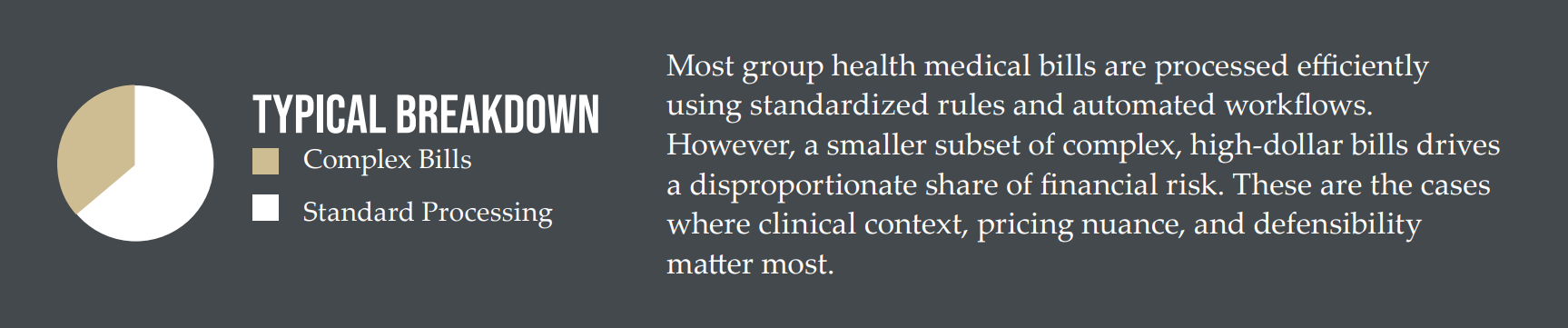
Sustainable cost management in group health requires more than faster processing or broader networks. As medical bills grow in complexity, effective oversight depends on principles designed for precision, not just efficiency.
A modern approach recognizes that accuracy, defensibility, and confidence must be built into payment decisions before funds are released, not recovered after the fact.
- Physician-led decision making: Complex medical bills require clinical context. Physician oversight adds judgment where automated logic falls short, particularly for inpatient and high-dollar services where nuance matters.
- Defensible pricing data: Payment decisions must withstand scrutiny. Transparent, supportable pricing data creates consistency while reducing exposure to disputes, audits, and downstream challenges.
- Automation paired with human review: Technology enables scale. Human expertise adds discernment. A modern approach blends both, using automation where patterns are clear and escalation where complexity requires it.
- Dispute readiness by design: Disputes are a reality of today’s billing environment. Preparing for them upfront reduces friction, shortens timelines, and protects both plans and members.
How Organizations Put This Thinking Into Practice
Acknowledging complexity without disrupting operations.
Most group health organizations do not overhaul their entire payment process at once. Instead, they introduce precision where exposure is highest, layering specialty oversight into existing workflows. This allows teams to improve accuracy and confidence without sacrificing administrative efficiency.

Common Engagement Patterns
Organizations often begin by:
- Targeting specific bill types with elevated risk
- Focusing on high-dollar or high-complexity medical bills+
- Applying specialty review alongside existing vendors
- Introducing controls prepayment rather than post-payment
These steps allow for measurable impact without requiring structural change.
What This Enables
This approach gives organizations greater confidence in payment decisions while reducing downstream disputes and escalations. It also improves transparency across teams and leads to more predictable medical spend outcomes.
- 70% – of high-dollar exposure typically concentrates in a small subset of complex medical bills.
- 39% – of disputes originate from charges that passed initial processing without deeper review.
Our People – What Success Looks Like
When Payment Decisions Feels Settled, Not Stressful
Success in group health does not show up as a single metric. It shows up as confidence. Confidence that payment decisions are correct, defensible, and aligned across clinical, operational, and financial teams. When that confidence is present, organizations spend less time revisiting decisions and more time moving forward together.
- Greater confidence in payment decisions
- Fewer downstream disputes and escalations
- Improved transparency across teams
- Reduced internal friction between stakeholders
- More predictable medical spend over time
Framing the Problem Before Choosing Solutions
Most group health organizations feel pressure to act quickly, often jumping straight to tools, vendors, or point solutions. This overview is designed to slow that moment down. Before deciding how to intervene, it helps to clearly understand where exposure originates and why it persists across different bill types, workflows, and teams. By grounding decisions in structure rather than urgency, organizations are better positioned to make changes that hold up over time. The goal at this stage is not action for action’s sake, but clarity about what actually needs to change.
Progress Starts With Focus
There is no single starting point that works for every organization. Some begin by examining specific categories of medical bills. Others focus on high dollar exposure, dispute volume, or internal process strain. The common thread is intentional focus. From here, organizations typically explore individual areas of exposure in more detail, aligning effort with where confidence is hardest to maintain today. The goal is not to do everything at once, but to move forward with clarity and purpose.
Featured Resource

Our Company Overview
Our “Company Overview” provides a snapshot of healthcare reimbursement and medical billing challenges we address, the standards that guide our work, how our solutions apply across markets, and where accountability through accuracy matters most.
Featured Resource

Our Bill Review System
Our “Bill Review System” outlines our approach to establishing payment accuracy and defensibility while protecting proprietary methodology, processes, and framework under NDA.
Featured Resource
Our Bill Review Guidelines
Our “Bill Review Guidelines” outline how we use UB-04s, HCFA 1500s, medical records, and itemized bills to validate facility and professional claims for accurate reimbursement.