


Article 1:
PDPTA and Section 7: What Plan Fiduciaries Need to Know
The Patients Deserve Price Tags Act (S. 2355) is intended to make healthcare pricing and spending more transparent. The main thrust of the bill is to provide transparent pricing for patients across healthcare services before care occurs.
For ERISA plans, however, Section 7 is particularly important.
It would give plan fiduciaries stronger access to the claims and payment information they need to understand where plan dollars are going and whether those payments are accurate.
Section 7 Would Strengthen Access To:
- Claims and encounter data
- Supporting payment and clinical documentation
- Audit and review rights
- Authorized business associates
- Protection against contractual restrictions and delays
That is meaningful progress. Improved access to information gives fiduciaries a better opportunity to understand and oversee plan spending.
Timing Matters
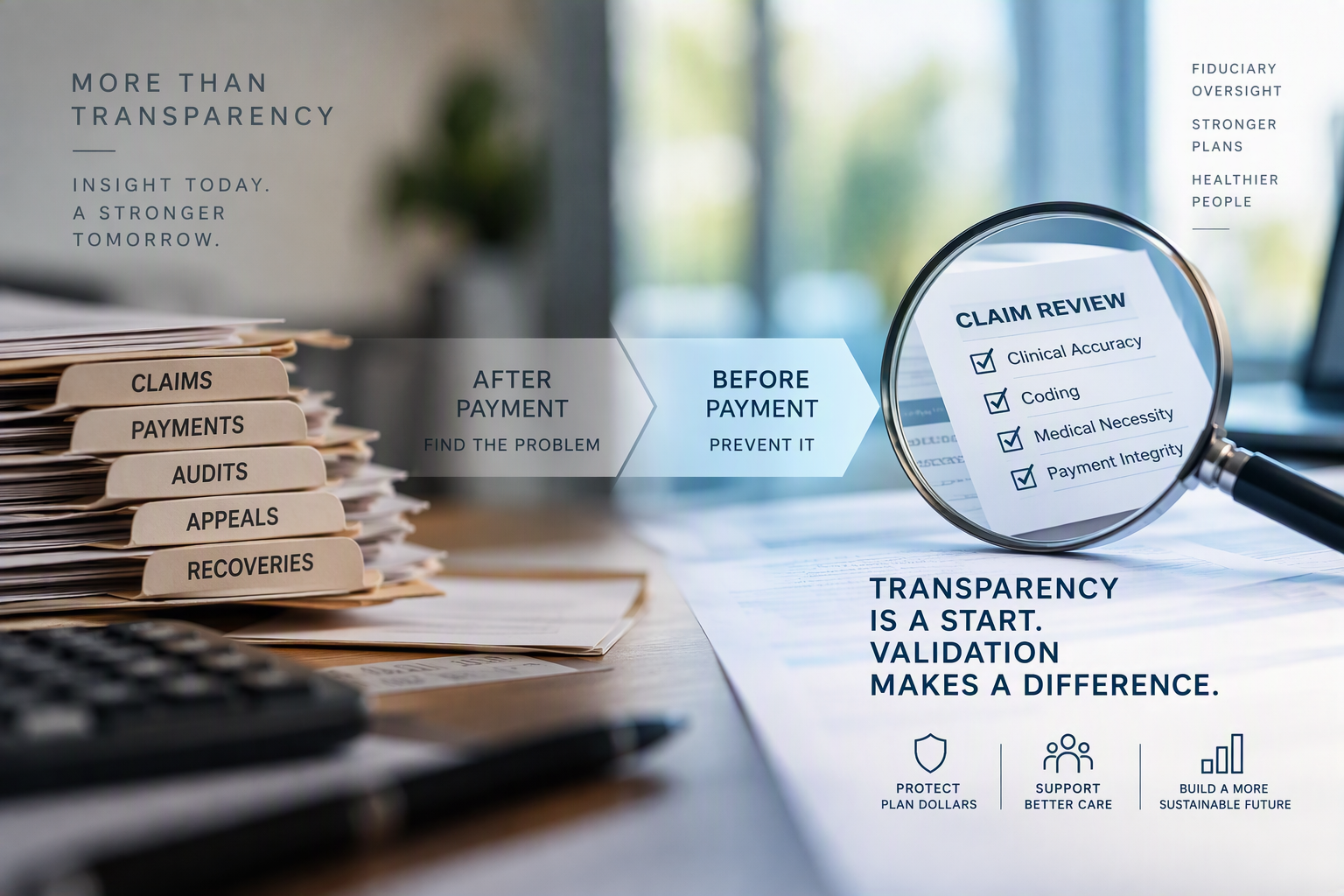
There is a big practical difference between finding a questionable payment after the fact and reviewing it before the money goes out.
Post-Payment
Claim paid → problem identified → audit or appeal → attempt to recover
Pre-Payment
Claim received → risk identified → targeted review → appropriate payment
Why Is Pre-Payment Preferred?
It can be faster and less expensive.
Questions can be resolved as part of the payment process instead of through a separate audit, appeal, and recovery effort.
Once the money is gone, getting it back can be difficult.
Recoveries can take years, become disputed, be reduced through settlement, or never happen at all.
Pre-payment can be better for the patient.
Post-payment recoveries often happen much later and across large groups of claims. Those dollars may never trace cleanly back to the individual patient who originally incurred the cost.
What About Patient Privacy?
Employers do not need access to an employee’s identifiable medical information to make this work.
A plan fiduciary can use an independent third-party reviewer operating under a HIPAA-compliant Business Associate Agreement to review the claim. That creates strict separation between the patient’s medical information and the employer.
The Takeaway
Section 7 would remove gag clauses and give plans access to post-payment information they may not typically receive today.
Shouldn’t plans also have the option to use that information through an independent reviewer before a questionable claim is paid?
Article 2:
What Every ERISA Fiduciary Needs to Know About the Pending “Patients Deserve Price Tags Act”
Our opinion on what it would do, why it matters, and most importantly, what it leaves unaddressed.
Imagine If Your Credit Card Had No Effective Pre-Payment Checks
Every transaction goes through. Questionable charges are discovered only afterward. Then come the investigations, disputes, and efforts to recover the money.
That would be a troubling way to run a payment system.
Now consider healthcare.
Plans already use claims edits and fraud controls, but important clinical, coding, and reimbursement errors can still escape detection until after payment.
For many plans, the missing capability is timely, independent validation before the dollars leave the plan.
Pending in Congress: S. 2355 has been reported by the Senate HELP Committee and remains under consideration. This is the time to understand what the proposal would change and what it would not. Perhaps there is enough time to improve it.
What the Bill Would Do
The Patients Deserve Price Tags Act seeks to strengthen patient-facing price information and machine-readable transparency.
Section 7 would expand access to claims, encounter, payment, and supporting information, reinforce audit and review rights, and address contractual obstacles to authorized data access.
Those provisions could provide greater visibility into plan spending and vendor performance.
Why That Matters to Taft-Hartley and Other ERISA Plans
Fiduciaries need reliable information to understand where plan dollars go.
But a retrospective audit answers a different question from a prospective payment check. Finding an error after payment is not the same as preventing an avoidable payment.
Retrospective: Pay & Recover
Claim paid → concern identified → audit or appeal → attempted recovery
Prospective: Validate & Pay
Claim received → risk flagged → targeted review → appropriate payment
Most Importantly: What Section 7 Does Not Expressly Establish
The current version of the Senate-reported bill does not expressly guarantee a voluntary right for all ERISA fiduciaries to contract with an independent pre-payment clinical and claims-validation service.
If authorized in the bill, this would provide a pathway to timely access to the identifiable information legitimately necessary for pre-payment clinical and financial integrity.
We live in a radically new information-processing world where such capabilities are now possible.
More data after payment does not, by itself, create a functioning pre-payment review capability. Access to data both pre-payment and post-payment is needed.
The Question for Every Fiduciary
Will transparency simply make it easier to see where plan money went, or can it also help ensure the right amount is paid in the first place?
Read the Bill. Understand the Benefits. Examine the Gaps.
Official Senate-reported text:
govinfo.gov/app/details/BILLS-119s2355rs
Focus: Section 7
Informational overview only. Independent prospective validation is a policy consideration, not an express entitlement in the Senate-reported bill. The credit-card analogy illustrates timing, not equivalence of payment systems.
